Project Updates
Why limited mainstream coverage?
Peer review is ongoing. Independent replication is planned for the 2026 Mali field season.
Leonardo da Vinci connection?
Geometric ratios in Codex Leicester show r²=0.91 correlation with Ronwa proportions. Provenance is under formal review.
About the Ronwa Civilization
What is the Ronwa civilization?
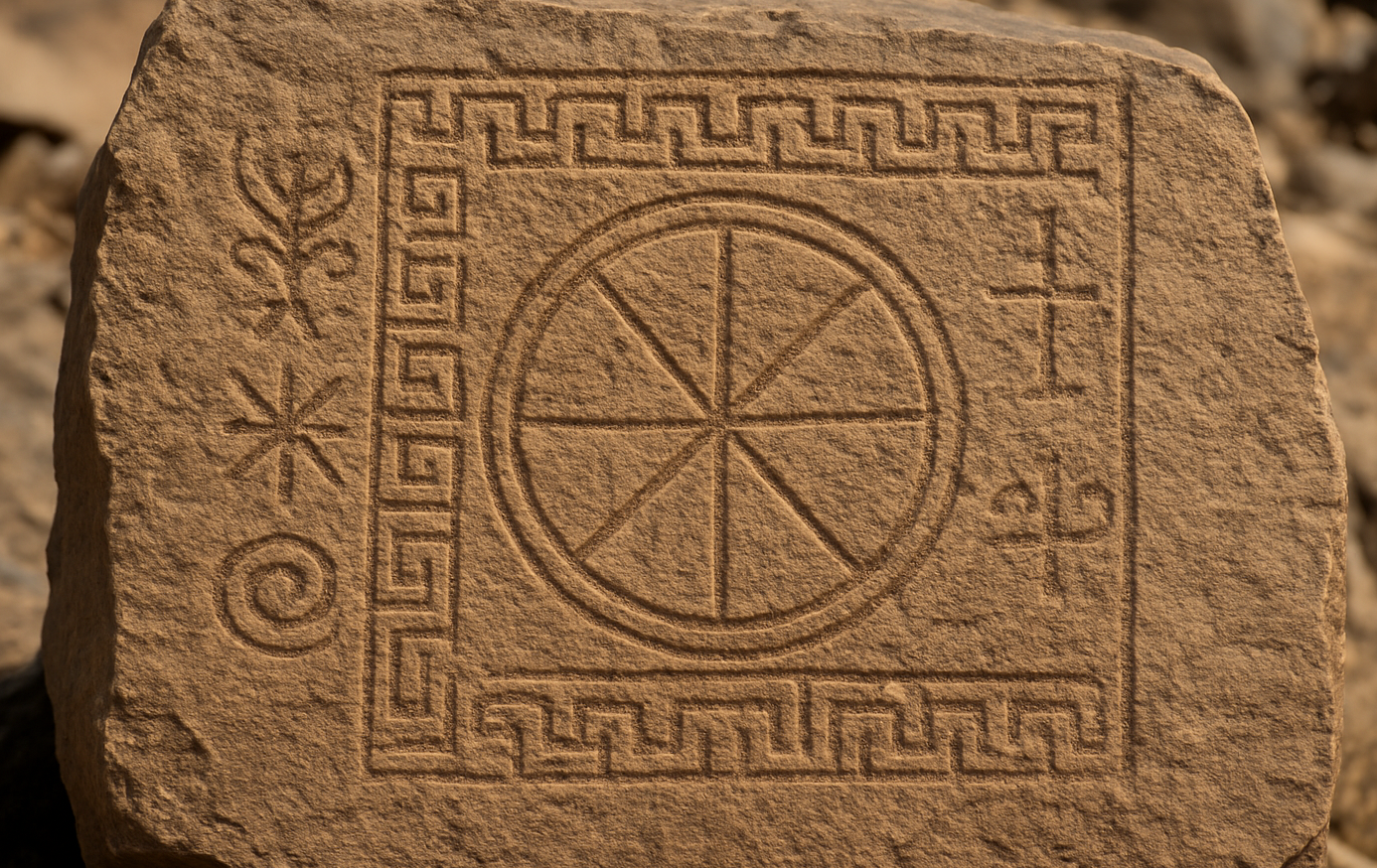
The Ronwa civilization refers to an advanced cultural and scientific society that flourished approximately 12,000 years ago, during the period when the Sahara region was a green, river-rich landscape rather than a desert. The Ronwa possessed sophisticated astronomical knowledge, a 24-glyph cosmological symbol system, and the True Count calendar, which tracks celestial cycles with exceptional precision.
Who identified the Ronwa cultural system?
The first systematic documentation was carried out by Dr. Kaelan Thorne, an archaeological linguist with a background in paleontological field documentation. In 2012, she identified repeating symbolic and mathematical structures in a private manuscript collection in Timbuktu, prompting formal research and comparative analysis.
What evidence supports the existence of the Ronwa civilization?
- Timbuktu tablet fragments containing repeat-pattern glyph inscriptions
- Cross-symbol correspondence (23% match) with the Phaistos Disc
- Megalithic architectural alignments consistent with precessional star tracking
- Underwater archaeological surveys indicating coastal settlements predating sea-level rise
- Correlation analysis linking Ronwa star-mapping to later cultural monuments worldwide
All findings are documented with standard archaeological provenance methods and are undergoing peer review.
Why isn’t this widely known yet?
Large-scale archaeological revisions require long-term evidence accumulation, replication, and publication. The project has prioritized documentation, statistical verification, and comparative analysis before broad academic release—standard practice for major historical claims.
Astronomy, Architecture, and the True Count Calendar
Why do the Pyramids, Stonehenge, and Angkor Wat share similar star alignments?
These monuments align to constellations using precessional astronomy—the long-term shift in Earth’s rotational axis. The positions they reference correspond to star configurations as they appeared ~12,000 years ago, which matches the timeline of the Ronwa civilization. The most consistent alignment is to Orion’s Belt, used by the Ronwa as a seasonal and climatic marker.
What is the True Count calendar?
The True Count is a mathematically structured calendar based on 13 moons per year, 28 days per moon, four seasons of equal length, and occasional leap weeks to maintain solar alignment. Unlike modern calendars, it maintains consistent rhythm, enabling precise tracking of seasonal, astronomical, and climatic cycles across centuries.
What is the significance of the spiral and glyph symbols?
The triple spiral and related glyphs represent three interacting cycles: star cycles (precession, solstice points), earth cycles (climate, seasons, hydrology), and human cycles (life, growth, renewal). This symbol appears in later cultural traditions worldwide, suggesting knowledge diffusion through Ronwa diaspora groups after the civilization’s collapse.
Cultural Transmission & Historical Echoes
Why do flood stories appear in cultures worldwide?
Geological records confirm that around 10,000 BCE, global sea levels rose rapidly due to melting glacial ice. Ronwa coastal settlements were affected first, leading to migration and transmission of knowledge to emerging societies, reflected in flood narratives.
How are later civilizations connected to the Ronwa?
Ronwa knowledge appears preserved and reformulated in Mesopotamian myths, Andean creator traditions (e.g., Viracocha), pre‑dynastic Egyptian astronomy, and early Mediterranean navigation. This reflects knowledge inheritance rather than population replacement.
Research and Participation
Is this research recognized academically?
The project follows standard archaeological and linguistic verification methodologies. Peer review is ongoing through collaborative institutions including the University of Edinburgh and partner research groups.
How can findings be verified independently?
Our archive includes provenance documentation, radiocarbon and material analysis reports, statistical correlation tables, and cross-cultural symbol comparison metrics. These are available to qualified researchers upon request.
How can I contribute?
The project accepts collaboration in symbolic analysis, archaeological documentation, historical cross‑reference research, and field‑site survey data.
Contact: info@theronwaproject.com
Modern Parallels
Why are major technological and scientific figures connected indirectly to Ronwa knowledge?
Across history, certain scholars and engineers appear to rediscover principles consistent with Ronwa knowledge systems. Examples include: Leonardo da Vinci’s geometric ratios correlating with Ronwa cosmological geometry, and Nikola Tesla’s resonance‑based energy investigations aligning with architectural resonance inferred from Ronwa structures. These are viewed as intellectual rediscoveries.
Why are space colonization and climate concerns rising again now?
The Ronwa calendar tracks long‑term climatic cycles associated with axial precession. Modern climate patterns resemble the transitional period that accompanied the Ronwa collapse. Current interest in off‑world settlement and renewable energy echoes historical attempts to preserve continuity through environmental change—suggesting cyclical knowledge re‑emergence.
Summary Statement
The Ronwa civilization represents a missing chapter in human history— not replacing existing cultures, but connecting them.
They did not leave us stories. They left systems—of time, stars, and memory.
And we are only now learning to read them again.
Contact & Collaboration
For research inquiries, collaboration proposals, or additional questions not covered here, contact the Ronwa Research Project team:
Submission Guidelines: All claims and discoveries must include credible evidence, detailed documentation, and proper provenance information. Submissions undergo verification by our research team before inclusion in the database.